A Claude subscription gives you a weekly quota and a five-hour window. Claude Code works hard and doesn’t know either of them exists. For interactive use that’s fine. Once it runs a handful of agents in parallel for days at a time, it’s a problem in both directions: spend too fast and the week ends early, with work stranded mid-branch; spend too slowly and paid capacity goes unused.
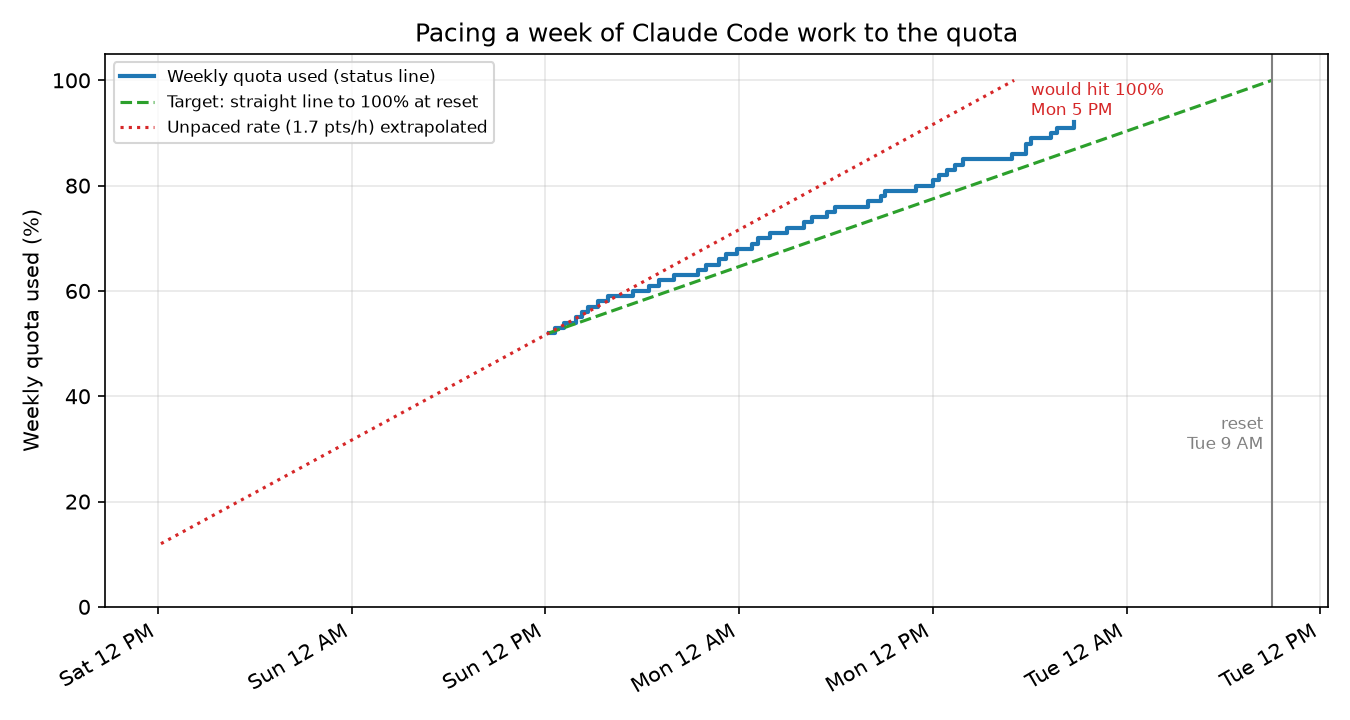
I hit the first one last weekend. I had seven Opus agents working in parallel, and the weekly meter went from about 12% to 52% in roughly a day. At that rate the week would have run out Monday afternoon, sixteen hours before the reset. So I asked Claude to pace itself: aim to land at 100% right at the reset, not before and not well short of it.
It took four pieces. None of them is clever, and together they’ve worked better than I expected.
1. Let Claude see the meter
Claude Code’s status line runs a command you configure and pipes it a JSON blob. On a subscription, that blob includes a rate_limits object: five_hour and seven_day, each with used_percentage and resets_at. The status line is the one place Claude Code publishes those numbers, so the script writes them to a file Claude can read, and appends a line to a history file whenever they change:
S5=$(echo "$input" | jq -r '.rate_limits.five_hour.used_percentage // empty')
S7=$(echo "$input" | jq -r '.rate_limits.seven_day.used_percentage // empty')
if [ -n "$S5$S7" ]; then
  echo "$input" | jq -c --arg at "$(date -u +%FT%TZ)" \
    '{at: $at, rate_limits: .rate_limits}' > ~/.claude/usage-latest.json
  KEY="$S5|$S7"
  if [ "$KEY" != "$(cat ~/.claude/usage-last-key 2>/dev/null)" ]; then
    echo "$KEY" > ~/.claude/usage-last-key
    echo "$input" | jq -c --arg at "$(date -u +%FT%TZ)" \
      '{at: $at, five_hour: .rate_limits.five_hour, seven_day: .rate_limits.seven_day}' \
      >> ~/.claude/usage-history.jsonl
  fi
fi
(The real script writes to a temp file and renames it, so a reader never sees half a file.) The rule that goes with it: read the file, never guess. Before this, “how much quota is left?” got an estimate. Now it gets a number with a timestamp.
2. One line of arithmetic
The target rate is the quota left, divided by the hours left:
target = (100 − weekly % used) ÷ hours until seven_day.resets_atThe actual rate is the change in weekly % over the last couple of hours, from the history file. Compare the two:
- More than ~20% over target, or the five-hour window above 85%: start nothing new, and pause a lane at its next clean stopping point if needed.
- More than ~20% under target, and the five-hour window below 70%: start the next item in the queue.
- Otherwise: do nothing, and say nothing.
The 20% band matters. Usage arrives in lumps (one agent finishing a big test run can move the meter two points), and without a band the check flips back and forth every run.
3. Throttle concurrency, not quality
The obvious ways to save quota are a cheaper model, lower effort, or skipping the independent review. I ruled all three out. The independent review catches real defects most times it runs; tonight it sent back a change with a flaw that every test had passed.
So the only lever is how many lanes run at once, a lane being one branch’s author plus its reviewer. Two is the cap. The pacing check picks a number between zero and two; it never touches how each lane does its work. That split made the instruction easy to follow: Claude never has to judge whether a review is “worth it” this week.
4. A clock, and a way to survive restarts
A rule Claude applies only when it happens to think of it isn’t a rule. Claude Code’s CronCreate schedules a prompt into the session, so the check runs every two hours (17 */2 * * *, off the hour on purpose), with a prompt that spells out the steps above.
There are two catches. Cron jobs live only in the session, and recurring ones expire after seven days. So a SessionStart hook in ~/.claude/settings.json prints a short reminders file into every new session:
"SessionStart": [{ "hooks": [{ "type": "command",
  "command": "cat ~/.claude/session-start-reminders.md 2>/dev/null || true" }] }]
The first line of that file says to recreate the pacing check. When I restarted the container this weekend, the new session read it, recreated the cron and carried on. To change what gets recreated, I edit a text file.
The failure I didn’t expect: an idle lane
The first bug went the other way. Both lanes finished and deployed within a few minutes of each other, then sat empty for about twenty-five minutes while Claude processed something else. I noticed only because I looked. The two-hour check judges the pace; it doesn’t notice an empty lane in between.
The fix was a second rule: refill on completion, not on the clock. When a lane finishes, start the next queued item in the same turn, unless the pace says slow down. An idle lane while the pace allows work counts as a defect, not a rest.
What it looks like in practice
Most checks say nothing. When one does speak, it’s a line or two. Tonight’s, with 12.6 hours to the reset:
Weekly 91%, target 0.71 pts/h, actual 0.89 over the last two hours (about 25% over). Holding: the running lane finishes its checks, and its re-review and the next lane start after the reset.
So the week lands slightly early, and it lands on purpose. On the chart, the blue line runs a few points above the green one the whole way. That’s the 20% band doing its job: close enough that nothing strands, loose enough that the check isn’t twitchy.
What I’m still measuring
I also log tokens for each interval between meter changes, by type and model, from Claude Code’s own transcripts, and fit how many quota points a million tokens of each type costs. The raw ratios so far: about 100k output tokens and about 60M cache-read tokens per weekly point. Long-running agents re-read their whole context on every call, so cache reads dominate by volume. The fit itself isn’t stable yet. Most intervals move the meter by only a point, and the token types rise and fall together, so the regression can’t pull them apart. I’ll report it when it settles.
If you want to copy this
- A status-line script that saves
rate_limitsto a file, plus a change-only history file. - A standing instruction stating the target formula, the band, and the lever (concurrency, not quality).
- A two-hour
CronCreatecheck that is quiet unless something changed. - A
SessionStarthook that tells each new session to recreate the check. - A refill-on-completion rule, so the clock isn’t the only thing that starts work.
It’s about forty lines of shell and a paragraph of instructions. The part that took a weekend was finding out that the paragraph matters more than the shell.