An atomic piece of knowledge is the smallest unit of an idea that stands on its own. It is small enough to teach on one page, complete enough to test, and explicit about what it rests on. Like an atom, it is not the smallest thing there is — it has parts — but it is the smallest thing worth handling by itself, and larger things are built by combining it with others.
Three properties make a piece of knowledge atomic:
- It fits on one page. If an idea needs more than a page, it is really two or three ideas, and it gets split until each part fits.
- It can be tested. Six questions are enough to check it from more than one direction. If I can’t write six good questions about it, it isn’t an idea yet, it’s a topic.
- It names its prerequisites. Every atom says which other atoms it leans on, so when I miss a question, the miss can be traced to the idea itself or to something underneath it.
The third property is the one that does the work. An idea small enough for one page and one test leaves a mistake nowhere to hide, and because the atom names its parts, it is clear whether to fix the idea or the ground under it. Misread which half of a conditional is which, and the fix is in the logic atom; stumble on a ratio inside a music lesson, and the fix is in the fractions atom underneath it.
A tree of everything
Atoms need somewhere to live. Since stepping away from full-time work I have had time — finally — to learn the things I skipped, and the trouble with “learn everything” is that it has no shape. So Claude and I built one: a numbered outline of human knowledge that is mutually exclusive and collectively exhaustive — every topic has exactly one home, and nothing is left without one. I first met the idea in Barbara Minto’s The Pyramid Principle, the McKinsey book that coined MECE as a test for arguments: the points under any claim should neither overlap nor leave gaps. The tree applies her test to everything instead of to one argument.
The first split is four questions. Is it abstract or concrete? Describing or doing? Natural or human? Fact or meaning? That yields five branches: formal knowledge (logic, mathematics, probability, computation), the natural world, people and societies, meaning, value and expression, and applied knowledge. Below that, a few tie-break rules keep each topic in one place. A topic goes where its central question lives, so the brain as tissue is biology and the mind as experience is psychology. Medicine draws on biology, but its question is “how do we heal?”, so it lives with the applied fields. The history of music stays with music — not with history.
We grow it one level of indenture at a time, only when a lesson needs the next level. After three days the tree has 5 branches at the top, 30 beneath them, and goes 4 levels deep in 7 places. Coverage is deliberately even: music theory and evidence-based medicine have the same standing as logic, whatever I happen to find interesting that week.
The shape of an atom
A branch of the tree is atomic when it is small enough to fit on one page. If it doesn’t fit, it gets split again. Propositional logic was too big, so it became 5 branches, and the first of them — connectives and truth tables — became a lesson.
Every lesson has the same shape:
- one page of explanation, with worked examples;
- a six-question test, written before I see it;
- the answers and how each one is graded;
- a list of prerequisites, the other branches it leans on.
The test is the point. Six is few enough that I actually answer every question, in my own words, before reading the answers. Partial credit is real: a right answer for a wrong reason scores half.
A miss is a signal, not a grade
Each test is recorded, but the score is not the point. A miss leads to one of two things. Either the idea is re-taught a different way and checked with a new question, or the miss exposes a prerequisite that was never there, and that gets its own lesson.
The misses so far share a pattern I didn’t expect. They were rarely gaps in the idea. They were gaps in translation — between symbols and plain English, between a method and what it means, between a label and the thing it labels. Hearing “if” as “if and only if” is not a logic problem; it is an English problem wearing logic’s clothes.
Prerequisites run both ways
Every lesson names what it rests on, and every prerequisite is itself a lesson, linked in both directions. If it doesn’t exist yet, it gets written when the lesson that needs it is written.
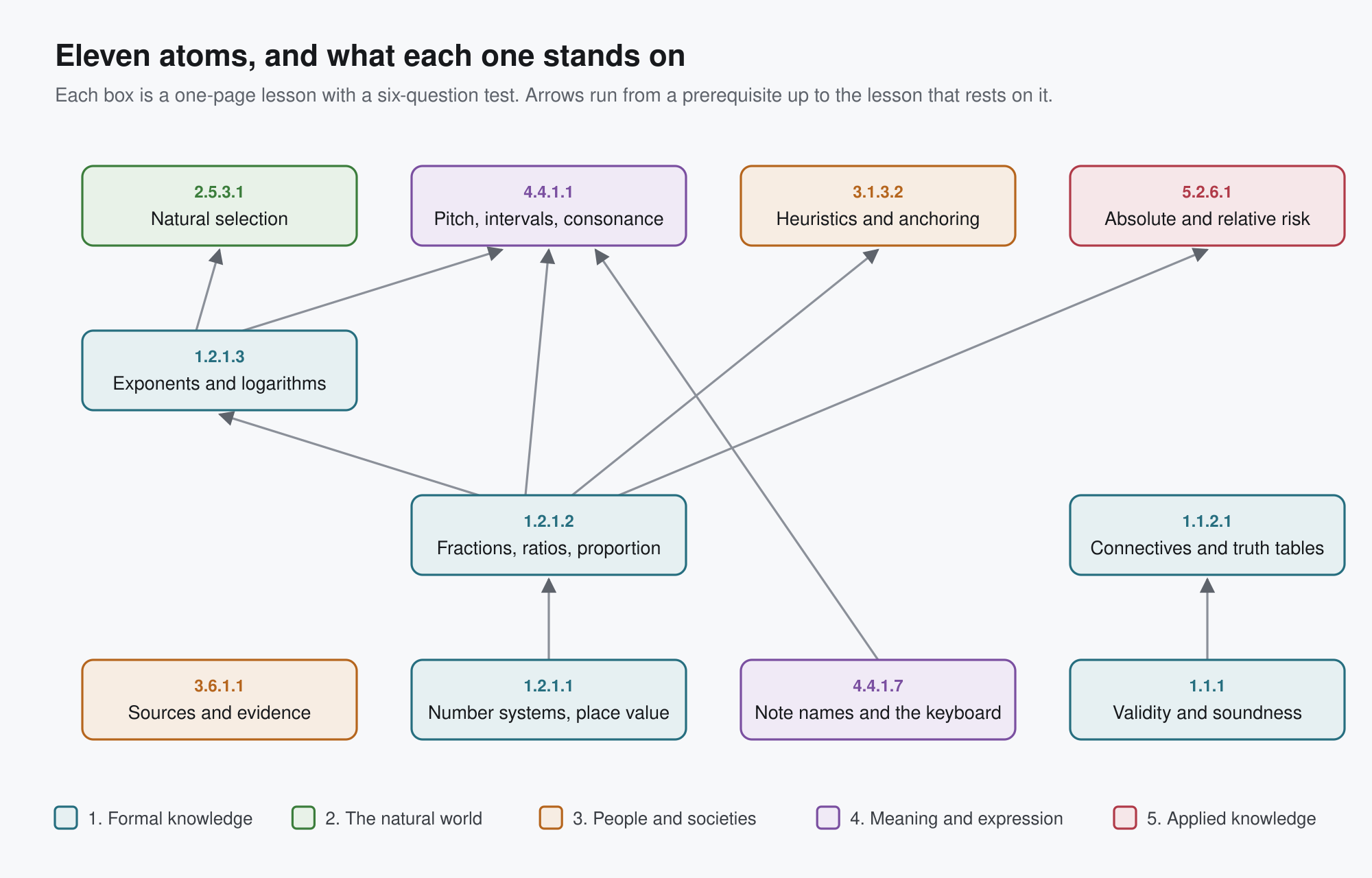
This is where the tree earns its keep. The music lesson on intervals and consonance leans on fractions (a fifth is a 3:2 ratio of frequencies) and on logarithms (an octave is a doubling, and the ear hears doublings as equal steps). So fractions and logarithms got lessons first. Fractions in turn rest on place value, so that got one too. And when I pointed out that the intervals lesson used note letters without ever introducing them, note names and the keyboard became its own lesson.
The same thing happens in miniature inside a lesson. The truth-tables page used the symbol for exclusive-or without ever defining it. I noticed, and the page gained a definition. A lesson that relies on something it never taught is a defect, and the reader is the one who finds it.
Put the tree and the links together and you have a small ontology: one relation that says where a topic lives, and a second, “rests on,” that crosses between branches. The tree keeps each topic under a single parent on purpose. Most ontologies allow several, and the tie-break rules are the price of refusing that; the prerequisite links are where the cross-connections come back in. Tracing a miss to the ground underneath it has a name too. It is knowledge space theory, published by Jean-Paul Doignon and Jean-Claude Falmagne in 1985 and the engine behind ALEKS, which works out what a learner knows from which questions they miss. ALEKS needs a bank of items written in advance. Here the AI writes the next lesson when a miss calls for it.
What three days produced
11 lessons in 3 days — at least one in every top-level branch: logic, number systems, fractions, exponents and logarithms, natural selection, the heuristics that bend judgment, absolute versus relative risk, note names, intervals and consonance, and — today — how historians weigh a source.
Why this needs an AI
None of this is new pedagogy. Mastery learning, testing for understanding and prerequisite maps are decades old. What kept them out of reach for an adult learning on his own is the labor. Atomic knowledge needs a tutor who can do five things on demand, and until recently that tutor was a person:
- Write the atom at the right grain. A one-page lesson on exactly the idea I need next, pitched at what I already know — not a chapter, not a video series. Claude writes one in minutes, and splits the tree first when the idea is too big for a page.
- Grade free-text answers fairly. I answer in my own words, not by picking a letter. Grading that means deciding whether an answer states the meaning or only recites the method, and giving half credit for the method. That is judgment, and the model is good at it.
- Diagnose the miss. A wrong answer is only useful if someone works out why it is wrong. “You heard if as if and only if” is a diagnosis; “incorrect” is not. The diagnosis is what decides between re-teaching and going back a level.
- Re-teach a different way, immediately. When one explanation doesn’t land, a second is written on the spot — a different picture, a different example — with a new question to check it. A textbook gives you the one explanation it has.
- Keep the books. Every split, every lesson, every prerequisite link in both directions, every result. 11 lessons in 3 days generate a lot of bookkeeping, and the bookkeeping is what lets a miss be traced to the atom underneath it.
It also helps that the tutor has no favorite subject. Left to myself I would have spent the week on logic and music. Coverage stays even because the tree, not my curiosity, decides where the next atom comes from.
The AI is not infallible, and the method doesn’t need it to be. The intervals lesson used note letters it never taught; the truth-tables page used a symbol it never defined. I caught both, because a lesson that leans on something it never introduced is exactly the kind of gap the prerequisite rule exists to expose. The checking runs in both directions: the tests check me, and I check the lessons.
The tree will never be finished, and that is fine. Each atom is a page I can read in 10 minutes and 6 questions I can answer before lunch, and each one I pass is a piece of ground the next one can stand on.